
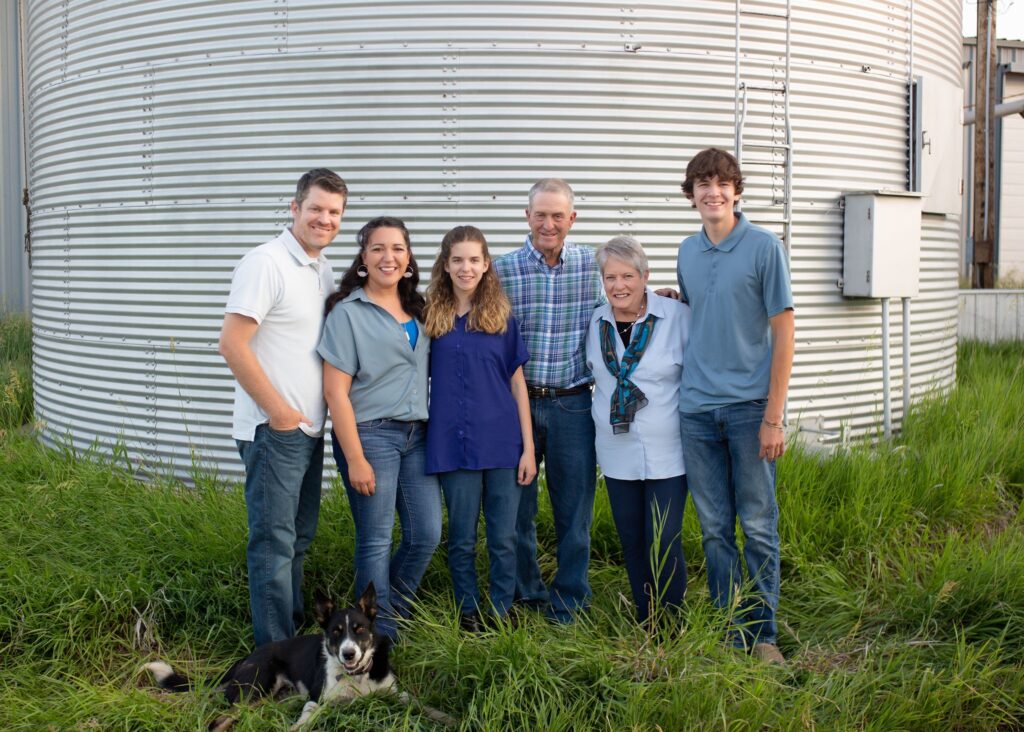
As we celebrate Agriculture Week during the USA’s 250th birthday year, it’s impossible not to reflect on the generations of farmers and ranchers who’ve built, fed, and sustained this nation over the years. Agriculture has always been a story of family, legacy, and the hope we have for generations to come. Every fence mended, every crop harvested, every herd cared for is tied to the hands and heart of someone who learned from the generation before them.
This month we feature a family that is a prime example of the heart it takes to sustain and build longevity into their farm. Heart and hard work! The Rock family also has decades of relationship with Central National Bank as Scott Rock is a co-worker of ours. It is an honor to get to know more about the Rock family as well as their extensive experience in the agricultural industry. Please enjoy as you read what they have been so gracious to share with us this National Ag Week.
Central National Bank: When did your family farm get its start?
Scott: The Rock family originally emigrated from the Germany area to Pennsylvania in the late 1700s and eventually settled in the Dickinson County, Kansas area in the late 1800s. Several families have farmed in the area since then, with my Dad, Loren, growing up on a farm north of Hope, KS. He began farming after graduating from Kansas State University in 1973 and has farmed with my mother, Carol, since 1979 in the Pearl, KS area. I have worked for Central National Bank since 2005 after graduating from Kansas State University and have helped with the farming operation with my wife, Valerie, after building a house on the farm in 2013. Our two children, Carter & Claire, have grown up on the farm and have been very involved in 4-H and FFA. Carter is now attending Kansas State University and plans to return to the farm upon graduation.
The farm is a diversified operation which includes growing wheat and soybeans and backgrounding cattle.
Can you summarize what it has meant to you to grow-up on your family’s farm? Any particularly significant lessons you could share with us?
Growing up on the farm shaped who I am. It taught me responsibility, hard work, and that work had purpose and decisions had consequences. Since many things on a farm take time to see results, it also taught me determination. Lastly, I learned quickly that farming is a profession that requires a lot of faith, since so many things, such as markets, prices, and weather, cannot be controlled.
For my parents, who started farming in the ‘80s when times were tough, they learned perseverance. They, too, learned determination and resiliency when things don’t go your way. They learned to think in decades, not quarters, because expanding a farming operation and improving the land are both things that take a long time.
A hot topic these days is that of Artificial Intelligence. How important has AI been to the agricultural industry? How has its application impacted your own family farm?
Artificial intelligence has long been used in modern agriculture, though not in the way AI is known today. In the late ‘90s, GPS and auto-steer technologies were brought to farming, which allowed for better application of seed, herbicide, and fertilizer. In recent years, many more technologies such as yield mapping, variable-rate seeding, and drones for monitoring crop health and spraying have been incorporated.
For my parents, these technologies have allowed them to do more with less–less manpower, less machinery, and less ongoing expenses. They allow for data-driven decisions, being able to apply inputs more precisely, and ultimately help to improve margins in the farming operation.
For myself, technology has allowed a way for me to get more involved in the farming operation while keeping my career in banking, since technology is my background.
For my son, AI and technology feel natural. He sees farming as a mix of soil science, engineering, and data analysis.
Similarly, what do people need to know about the way technology is changing agriculture?
Modern agriculture is very different than farming was when my Dad was young. Back then, much of farming was guess work. Today, it’s precision management. New seed varieties and herbicide technology have allowed for improved yields to produce more food on fewer acres (when the weather cooperates, that is!). As the world’s population continues to increase, food production needs will only continue to rise, so technological enhancements to agriculture will continue to be needed in the future. Today’s tractor or combine cab often looks more like an airplane cockpit than the open air, smaller machinery used in the mid 1900’s.
Are there specific technological innovations that you consider to be pivotal? Do you see a downside to technological advancements?
One very pivotal farming technology was the advancement of no-till farming in the mid ‘90s. This eliminated the need to till the ground, which improved soil by increasing organic matter and retaining more moisture. In addition, manpower was reduced since making multiple trips across the ground to till the land became unnecessary.
While all the technologies I mentioned before have become very important and valuable to farming, there are some downsides. First of all is the cost. Many new tractors and combines often cost between $500K to $1 million. As quickly as this technology advances, older technology also becomes obsolete, requiring continued costs to keep machinery up-to-date.
There’s also the downside of over-reliance on technology. For a personal story on that, shortly after we implemented prescription-based planting, Dad was trying to test fields to determine which one was dry and to ensure the planter was working. Since we had not yet created prescriptions or pushed work plans down from the cloud to the tractor, the planter wouldn’t even function, rendering his attempt to plant useless until the work plan could be pushed. Technology is a tool, but it still requires oversight, management, and expertise.
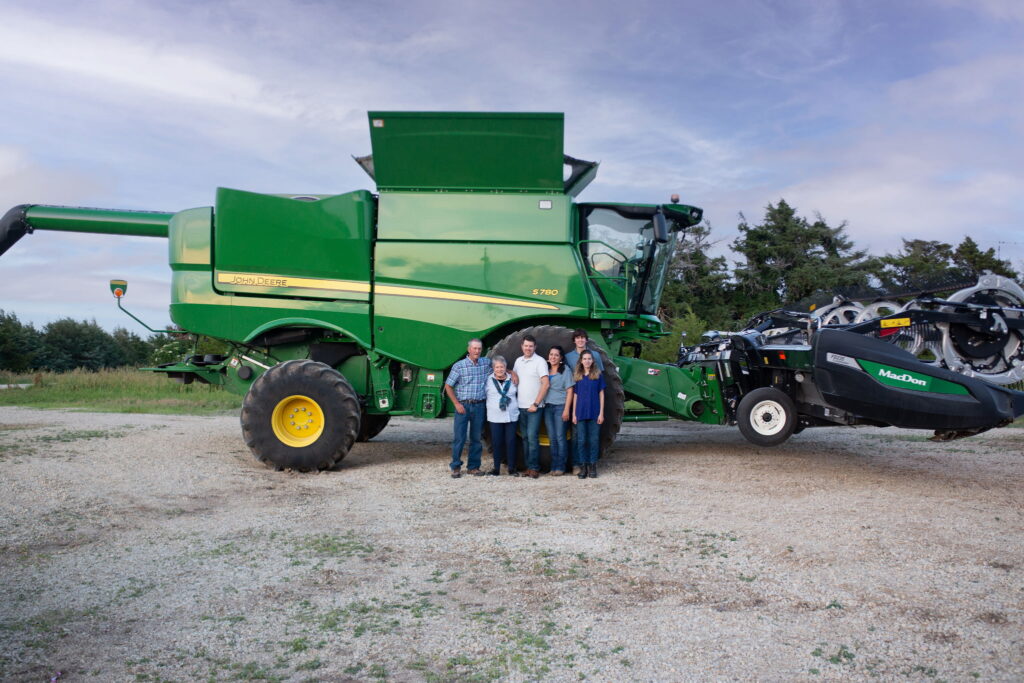
How does education look different for you and/or your children who may take over the farm as compared to your parents?
Years ago, farming was more physical labor. Today it’s capital-intensive and technology-driven. A college education isn’t required to farm, but it has sharpened how we farm. My dad went to Kansas State. I did as well. Now my son is there. Education didn’t replace hard work or experience, but it strengthened decision-making–especially in areas like agronomy, finance, and technology. Farming today requires business skills as much as mechanical skills.
What should people look for in the future? Do you have any predictions?
In the future, I expect there to be even more automation, especially things like autonomous field work that can be controlled from afar. There will also be greater AI-driven technologies and decision-making. This will likely lead to more consolidation of farms into larger operations, unfortunately, because realizing the benefits of ag technology will require more capital and technological expertise. Agriculture will always depend on soil, weather, and risk-taking–but farms that succeed will learn to combine data-driven management, adaptability, and strong balance sheets.
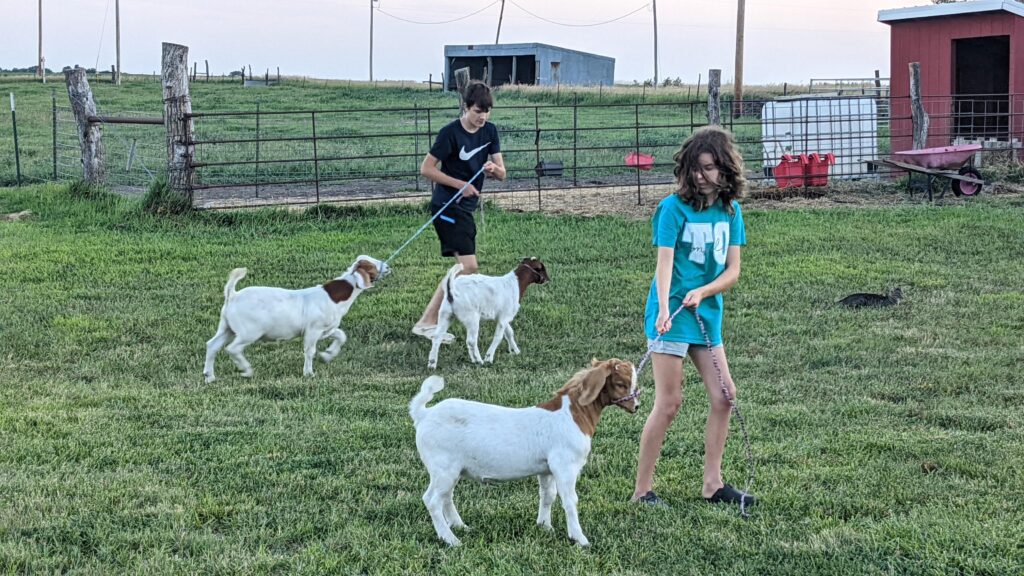
No farm story would be complete without hearing from the kids. From favorite chores to the animals that cause the most trouble, we asked Claire and Carter a few questions about life on the family farm.
Central National Bank: What is the funniest thing you’ve seen on the farm?
Claire: My brother found two opossums in the barn and brought them up to the house and rang the doorbell. When I opened the door, he was standing there with one in each arm. I laughed but it did kind of freak me out. Another time was when our miniature donkey got out of the pasture and wouldn’t go back in for anyone else except me when I offered him some treats.
Carter: One time, a plane was spraying a field right next to one of our pastures with about 40 head of cattle in it. The plane spooked them, and they ran straight through the fence. Funny enough, when the fence broke and made noise, it scared them again, and they ran right back into the pasture.
What is a lesson or two you’ve learned from growing up on your family’s farm?
Claire: I learned the lesson of hard work and that sometimes it’s important to do things I may not want to do, like the chores to take care of and train my livestock.
Carter: Hard work is important even when you don’t want to because the weather doesn’t wait.
What would you tell someone who has never been on a farm for an extended period of time? What do I need to know or understand?
Claire: Farming is hard work and has to come first sometimes like during harvest or when it’s time to do chores.
Carter: There are never set workday hours. Things can happen at any moment, and you always have to expect the unexpected.
What are your favorite and/or least favorite aspects of growing up on a farm?
Claire: My favorite is gaining new experiences that I never would have if I hadn’t lived on a farm, like caring for animals. My least favorite is that it can be a dirty job sometimes, and you may have to go outside to work even when it’s super hot or cold.
Carter: One of my favorite aspects is growing up and learning how to work hard. I also liked living out in the middle of nowhere, and I could do many things I wouldn’t be able to in the city.
Member FDIC